

TraIf you are managing a road project in California, a temporary traffic control plan is not optional. It is a requirement. Whether you are closing a lane on a city street or managing a full road closure on a state highway, your plan must meet both Caltrans standards and federal MUTCD guidelines.
We put together this guide to help contractors, project managers, and public works teams understand exactly what a compliant temporary traffic control plan includes. If you need help building or executing one, California Traffic Safety is here to handle it.
What Is a Temporary Traffic Control Plan?
A temporary traffic control plan (TCP) is a site-specific document. It shows how traffic will be managed during construction, maintenance, or utility work in or near a roadway.
The plan maps out the work zone in detail. It identifies where workers will be, where lanes will shift or close, and how drivers and pedestrians move safely through the area.
In California, TCPs must follow the Caltrans Highway Design Manual and the Manual on Uniform Traffic Control Devices (MUTCD). Projects on state highways require Caltrans review and approval. Local agency projects typically go through the city or county.
Submitting a plan that does not meet these standards delays your permit. That delays your project. Getting it right the first time matters.
The Six Core Components of a California TCP
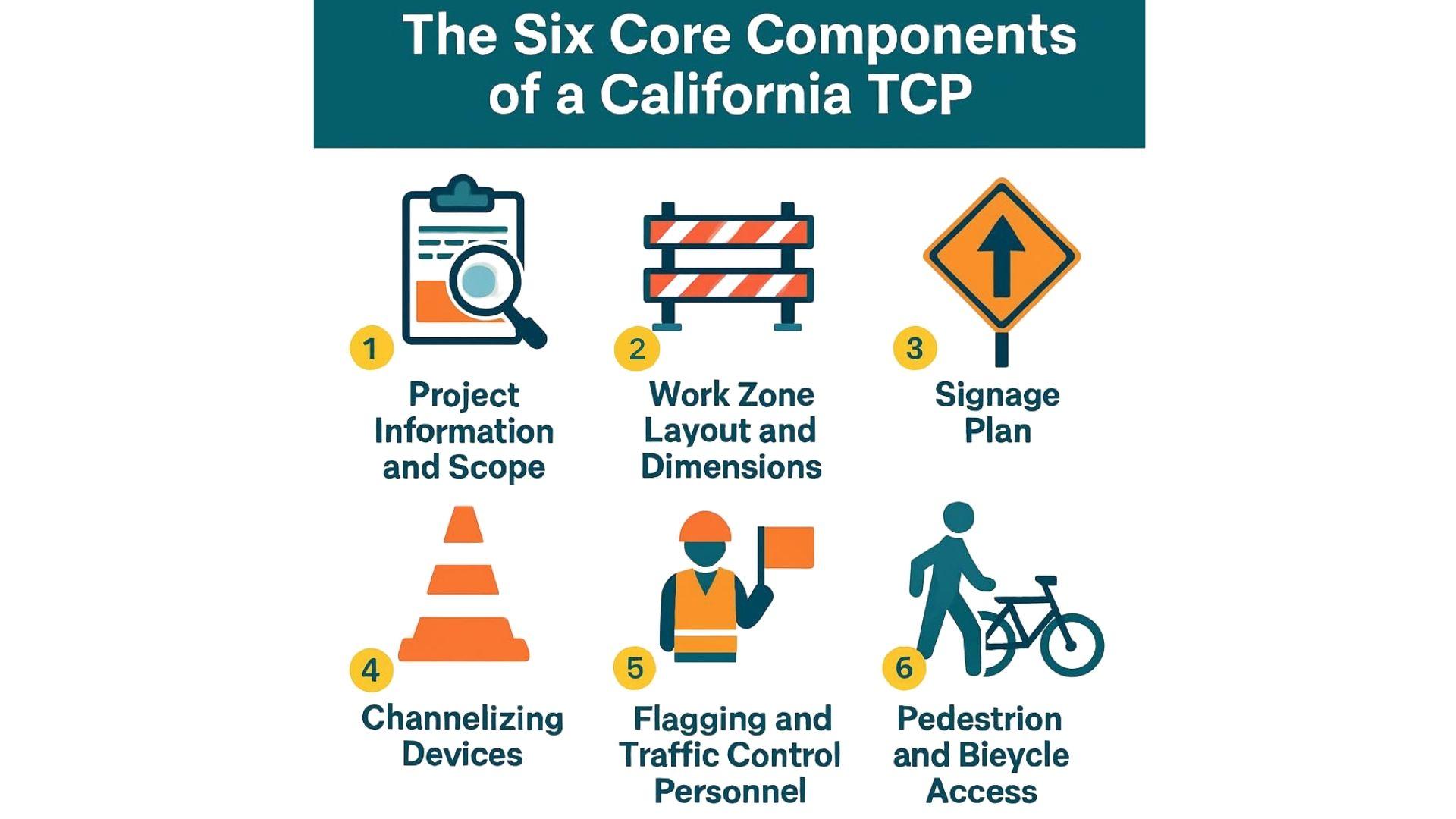
1. Project Information and Scope
Every TCP starts with basic project details. This includes the project location, the type of work being performed, the expected duration of the closure, and the hours of operation.
Caltrans and local agencies use this information to evaluate traffic impact. Be specific. Vague scope descriptions are one of the most common reasons plans get sent back for revision.
2. Work Zone Layout and Dimensions
The plan must show a scaled diagram of the entire work zone. This includes four distinct zones recognized under MUTCD standards:
The Advance Warning Area alerts drivers that something is ahead. Signs like “Road Work Ahead” and “Be Prepared to Stop” fall in this zone.
The Transition Area moves traffic out of its normal path. Tapers, cones, and channelizing devices guide drivers through lane shifts or merges.
The Buffer Space provides a safety cushion between moving traffic and the active work area. No workers or equipment belong in this zone.
The Termination Area returns traffic to normal. This is where the “End Road Work” sign goes.
Each zone has specific minimum length requirements based on posted speed and road type. Those dimensions must appear clearly on the plan drawing.
3. Signage Plan
Your TCP must list every sign used in the work zone. That means sign type, placement location, mounting height, and spacing between signs.
California follows Caltrans Standard Plans for sign placement. Signs must meet retroreflectivity standards so they are visible at night and in low-light conditions.
Common temporary signs include lane closure ahead, flagger ahead, one-lane road, and detour markers. If your project requires custom or specialty signs, our sign shop fabricates them to Caltrans spec.
Missing or incorrectly spaced signage is a fast way to fail a plan review. It is also a serious liability on the job site.
4. Channelizing Devices
Cones, drums, barricades, and delineators are all channelizing devices. Your plan must specify which devices you are using, how many, and where they are placed.
Device spacing depends on the speed limit of the road. Higher speed roads require tighter spacing to give drivers adequate guidance. MUTCD Table 6H-3 provides the spacing tables California inspectors reference.
Devices must also meet NCHRP 350 or MASH crashworthiness standards. This is a detail some plans miss entirely.
5. Flagging and Traffic Control Personnel
If your work zone requires a flagger, the TCP must show where they will stand and how they will coordinate with other flaggers if more than one is needed.
California requires flaggers to hold a current certification. Your plan should confirm that all flagging personnel meet this requirement.
California Traffic Safety‘s flagging crews are trained and ready to deploy. We integrate seamlessly into projects of any size across Sacramento and Northern California.
Note: California Traffic Safety does not offer flagger training or certification classes.
6. Pedestrian and Bicycle Access
This is one of the most frequently overlooked elements in California TCPs. ADA compliance does not pause for construction.
If your work zone affects a sidewalk, crosswalk, or bike lane, your plan must show an accessible alternate path. That path must meet ADA width and surface requirements. Temporary curb ramps may be required at crossings.
Ignoring pedestrian access is not just a plan review problem. It opens the project owner to ADA complaints and civil liability.
When Do You Need a TCP in California?
You need a TCP any time your work affects the traveled way. This includes:
- Lane closures on any public road
- Full road closures
- Utility work in or adjacent to travel lanes
- Sidewalk closures that redirect pedestrian traffic
- Nighttime construction on state highways
- Special events that require road or lane restrictions
Projects on state routes always go through Caltrans. Local street projects go through the city or county traffic engineering department. Either way, a permitted and approved TCP must be on site before work begins.
Let California Traffic Safety Build and Execute Your Plan
Writing a compliant TCP takes expertise. Executing it takes experienced crews and the right equipment.
California Traffic Safety is a DBE, WBE, and SB-Micro certified traffic control company serving Sacramento and Northern California. We hold C31 and D42 licenses. We build temporary traffic control plans, supply all required signage, and provide flagging personnel to keep your project moving safely and on schedule.
Visit our traffic control services page to learn more. Contact us online or call us directly.
California Traffic Safety 835 57th St. Sacramento, CA 95819 (209) 469-2663